
Warning: Only the first byte will be assigned to the string offset in /home/sites/healthwatchnorthumberland.co.uk/public_html/wp-content/plugins/eventON/includes/eventon-core-functions.php on line 1101

Warning: Only the first byte will be assigned to the string offset in /home/sites/healthwatchnorthumberland.co.uk/public_html/wp-content/plugins/eventON/includes/eventon-core-functions.php on line 1101
Projects Archives - Page 13 of 30 - Healthwatch Northumberland

Archive for category: Projects

How are you feeling? campaign report

How are you feeling? campaign report

How are you feeling? Linking with young people in Northumberland

Like many organisations, Healthwatch Northumberland wants to be better at hearing directly from young people about their experiences of healthcare. In spring 2023 we developed a campaign with the help of young people, entitled ‘How are you feeling?’ to gain an insight into the actual state of children’s and young people’s health and wellbeing in Northumberland.

The project was led by our high school student volunteers. They designed and piloted a survey, an explainer video and promotional materials as part of the campaign to ensure it was attractive to young people. We worked with secondary/high schools and colleges in the county to promote and distribute the survey to their students, and also promoted the campaign more widely. An accessible version of the survey was also made available.

Who did we hear from?

We had a total of 651 responses from young people aged between 13-24 years old. Most of the respondents to the survey were aged 13-15 years old. Over two fifths of the respondents were aged 13 years with just under a fifth of the respondents aged 14 years old and approximately a fifth were aged 15 years old.

Conclusions

Based on the findings from our campaign, those young people of Northumberland aged between 13 – 15 years old are generally happy in themselves. Respondents to our accessible survey were even happier overall than the respondents to the main survey. Both sets of respondents also feel happy with the service provided by the NHS but there were concerns about the length of waiting times. However, there was some ambiguity in the answers whether that was the length of time spent on a waiting list to receive an appointment or the length of time spent waiting at an actual appointment.

Read our report: How are you feeling? Linking with young people in Northumberland.
What you told us: September 2023

What you told us: September 2023

Health and social care feedback Northumberland September 2023

This month we heard from 268 people about health and social care services; either as a service user, or a carer or family member. The main issues were around getting a GP appointment and getting through to the surgery on the telephone. We did however hear a lot of praise for the quality of care once seen by healthcare professionals at the surgery.

We also heard that some people are not receiving all of their prescription medication from the pharmacy, where there are issues with supply. The third main area we had feedback on was mental health services, and how getting an appointment can be difficult, and communication could be better.

What did we get up to?

As well as our regular Here to Hear drop-ins in East Bedlington, Blyth, Morpeth, Prudhoe and Alnwick, we were out and about hearing from people at other events including a SeaFit event in Amble with the Fishermen’s Mission, Northumbria Cancer Patient and Carer Group’s Health and Wellbeing event in Haltwhistle, Queen Elizabeth High School Freshers’ Fair in Hexham and a drop-in session in Newbiggin.

Find out more in our September 2023 feedback report

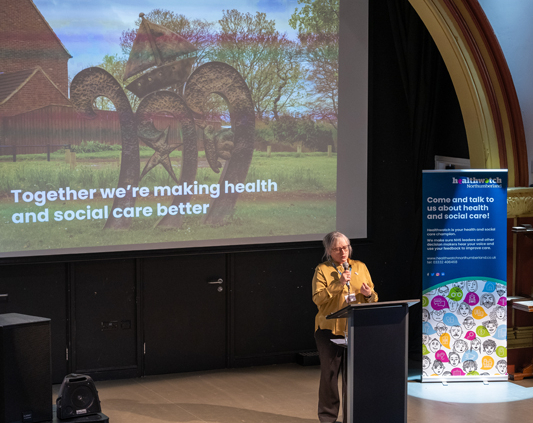
AGM 2023 – that’s a wrap!

AGM 2023 – that’s a wrap!

Online event – Stroke Association

Online event – Stroke Association

Join us on Friday 17 November, 1pm-2pm to hear a presentation from Janet Nesbitt, a volunteer from Stroke Association. (Please note this event has been rescheduled from Friday 10 November).

In this free, online public event Janet will provide an overview of stroke, including risk factors, stroke effects and what to do if you think someone is having a stroke.

We will also hear about local and national Stroke Association services, including support for stroke survivors and their carers, how to access advice and information and opportunities for volunteering. There will be a chance to ask questions.

Register now and we will send you a link to join closer to the event: bit.ly/Stroke-Association-Nov-23

This event has now passed.

Prescription medication

Prescription medication

Your experiences of getting prescription medication

People rely on prescription medication to treat and manage their conditions and keep well. Healthwatch England highlights the challenges people have recently reported when trying to get prescription medication.

In 2021/22, over a billion prescription items were dispensed in the community in England, up 2.58% on the previous year.

People rely on prescription medication to treat and manage their conditions and keep well. Yet, Healthwatch’s recent analysis of public feedback shows people are increasingly facing barriers to getting prescription medication.

Trends in feedback 

Analysis of public feedback given to Healthwatch across England suggests people have been facing serious issues when trying to get prescription medication:

  • Shortages of medication
  • Delays in getting repeat prescriptions issued
  • Shortages of staff
  • Closed pharmacies

Read the full article on the Healthwatch England website.

We’d like to hear more about what is happening in Northumberland. Please tell us if you have experienced difficulties with getting your prescription medication, or where services are working well for you and your family – give feedback.

Self-harm support online event

Self-harm support online event

Self-harm support online event

Join us on Friday 13 October, 1pm-2pm, for our next free online lunchtime event to hear from Jenny Groves, Founder and CEO of Battle Scars.

Battle Scars is a survivor-run charity providing support to those affected by self-harm.

Jenny will talk to us about the myths and realities of self-harm and the services and support available. This session is suitable for people who self-harm and family, friends or professionals supporting those who self-harm.

There will also be a chance to ask questions.

Sign up to our newsletter to be the first to hear about upcoming events.

This event has now passed

Join us for our AGM 2023

Join us for our AGM 2023

You’re invited to our AGM!

Wednesday 18 October 2023, at East Bedlington Community Centre.

Our AGM 2023 is a chance to hear about our work over the past 12 months, our plans for the coming year, and to meet our staff, board and team of volunteers. We will be joined by Gill O’Neill, Executive Director of Public Health, Inequalities and Stronger Communities at Northumberland County Council. She will talk to us about a strengths-based approach to tackling inequalities in the county and how the voice of residents is being listened to as part of the Northumberland inequalities plan. There will be a chance to ask questions.

This free event is for you if you live or work in Northumberland and have an interest in NHS or adult social care services.

We will start at 10.00am with tea and biscuits, with the main event kicking off at 10.30am. The event will finish at approximately 12.00pm and you will be welcome to stay for a light lunch with us.

.

If you would like to submit a question to be asked at the event, please send it to: info@healthwatchnorthumberland.co.uk.

If you have any special dietary requirements or accessibility needs please get in touch.

The centre is on several bus routes and there is plenty of parking nearby. Please ask if you would like any more information on getting to the venue.

We have invited specific groups of people to join us in the afternoon to be part of our ‘Community Conversations’ sessions. Here, our guests will be able to ask questions about issues that affect them and their communities, putting these questions directly to providers and commissioners from the NHS and the local authority, who will be there to listen and work with the groups to provide answers and solutions.

This event has passed

What you told us: August 2023

What you told us: August 2023

Health and social care feedback Northumberland August 2023

This month you told us that waiting times for GP appointments and poor communication from practices were an issue for you. We also had a lot of feedback about hospital services – waiting times, the distance you had to travel to hospital and communication issues – but you also praised the quality of care you received in hospital.

Once again we heard about the difficulties people are having trying to register with an NHS dentist. Read Healthwatch’s response to the annual NHS dental statistics for England.

Our online session in August was from the West Northumberland Living Well Service team, who told us more about social prescribing and how to access this free service.

Read more in our short report for August 2023.

Care challenges for neurodiverse people

Care challenges for neurodiverse people

Neurodiversity is a word used to describe the different thinking styles that affect how people communicate with the world around them. It includes dyslexia, autism, Attention deficit hyperactivity disorder (ADHD), Tourette’s Syndrome and more. Neurodivergent people encounter challenges accessing services that meet their needs. It affects a substantial proportion of the UK population. It has been estimated that 15% of the UK population could be neurodivergent.

Healthwatch England looked at the healthcare issues that neurodivergent people can face.

In 2021, the government published its five-year strategy to reduce inequalities for autistic children, young people and adults. It commits to improving the timeliness of autism diagnoses and training of health and social care staff so that they understand and meet the needs of autistic people.

This is welcome, as our evidence shows that neurodivergent people struggle to access services which meet their needs.

Long waits

We heard about long waiting times for diagnoses and support, with people passed from pillar to post in their quest to get support. The long waits can be very disruptive for children and young people.

“My son is 10. He has extreme anxiety, which prevents him from attending school and daily activities. He has previously tried to attack myself and siblings with hammers, scissors etc and has been suicidal with threats to take his life.

As he is suspected autistic, which we have been told the diagnosis is two to four years for, CAMHS declined to help as they can’t deal with autistic children apparently. GP can only refer to CAMHS. Early help sent us a woman whose only suggestion was a sticker chart.

No one is willing to help my son. We have been told our only option is to call the police when he goes into meltdown who will take him away, which would cause him and our family extreme trauma and still wouldn’t enable him to access any help.”

– Story shared with Healthwatch England

Lack of accessible support and information

We’ve also heard that neurodivergent people struggle to get the proper support or information in a suitable format to enable them to engage with health and care services.

Phone appointments, waiting areas that overload the senses, changing appointments at short notice, a lack of continuity of care and professionals who don’t take the time to reassure can cause neurodivergent people anxiety when trying to get support from services.

“Communicating my private health needs to a complete stranger is very difficult for me. I need to speak to someone who knows me. This is typical of someone who is neurodivergent but the system is set up for neurotypicals who can navigate it.

In my mind this is discrimination. I am being forced to conform to something I cannot do, process, cope with and learn to manage.

Neurodivergent people cannot learn to be neurotypical anymore than the blind can learn to see or wheelchair users manage without ramps/stairs.”

– Story shared with Healthwatch England

Lack of support after diagnosis

Healthwatch Northumberland researched issues raised by parents and carers of autistic children and young people in Northumberland. They reported parents mentioned a lack of follow-up support after receiving a diagnosis and a feeling of being left to do their own research about their or their loved one’s condition, how to manage it and support available.

“As soon as they were eventually diagnosed they were discharged and we were told it was up to us to research and learn how to support them”.

Read the full report.

How can we improve patient experience for neurodiverse people?

One answer to this is ensuring that the Accessible Information Standard is adhered to across services.

This sets out what steps health and social care services should take to ensure that people are given information about their health and care in a format they can understand.

However, our research on the Accessible Information Standard found that people who need information in a format they can understand struggle at every stage of their healthcare journey.

Freedom of Information Act requests asked NHS trusts how well they comply with the Standard. They found that only a third of those who responded said they were fully compliant.

Therefore, we have called for a review of the Accessible Information Standard. We worked with NHS England to feed in the findings and recommendations of our work into the review.

Please get in touch with your experiences of accessing and receiving care, as a neurodivergent person or as the parent or carer of someone who is neurodiverse.

X