Sight loss services project

Sight loss services project

Understanding the support available for people with sight loss in Northumberland

Contracting organisation: Adapt North East
Contract value: £5,500
Delivery period: March 2022 to June 2022

Healthwatch Northumberland was established in 2013 and is delivered by Adapt (NE) based in Hexham. As defined by the Health and Social Care Act 2012, Healthwatch Northumberland is the independent champion for health and social care across the county. Our role is to give a voice to people who use services, encourage, and influence positive change to services and help meet the health and social care needs of the population.

Contract purpose and focus

This project will learn about the experiences of people in Northumberland who, in the last three years, have been issued with a Certificate of Visual Impairment. This could be due to a diagnosed eye condition or resulting from a health condition or incident (diabetes, stroke etc).

The ‘sight loss pathway’ aims to promote independence and autonomy for adults with sight loss to ensure that services are well coordinated across health and social care. The project will map the current eye care pathways and use the Seeing it My Way outcomes to gather people’s experiences before, during and as we come out of the pandemic. It will seek to understand what services have worked well and ideas for improvements.

This will require desk research, questionnaires/interviews with service providers and commissioners and interviews with people who have used services. The project’s key output will be a report describing the service user and where appropriate, carer experience, highlight good practice and make appropriate recommendations for changes or improvements. The report will be public and will be discussed with Northumberland County Council and health service commissioners and providers before publication.

We anticipate the project will use a mixture of structured and semi-structured individual interviews and possibly focus groups if relevant. The minimum number of participants required who have sight loss is ten. It is important that people from across the county and diverse communities can participate and that participation is accessible to people with sight loss.

Given the on-going Covid-19 situation using online, or telephone methods are acceptable ways to gather feedback. Physical meetings are possible if allowed within Covid-19 restrictions and subject to thorough risk assessment.

1. Contract duration and dates                                                                       

Tender issued: 10 February 2022
Submission deadline: 1 March 2022
Notification by: 10 March 2022
Work to commence: by end March 2022
Interim review: by 30 April 2022
Delivery of draft report: by 4 June 2022

2. Outputs

The key output required is a report with anonymised information:

a) Describing the process, findings and drawing on these to make any appropriate recommendations for further action by Healthwatch Northumberland, commissioners and service providers. The report should include an Executive Summary.

b) Two short case studies which represent the key theme(s) from the findings.

3. Conditions for participation

Applications are invited from suitably qualified and experienced individuals or organisations who demonstrate:

a) The ability, capacity, and commitment to meet the delivery timescale.
b) Knowledge or experience of the operation and purpose of sight loss care pathways and services.
c) Understanding of the ways in which patient and carer experience and voice can be used to influence service delivery.
d) Understanding of health and social care provision in Northumberland with a mixture of rural and urban areas, diverse and isolated communities.
e) Ability to work sensitively and appropriately with participants and with due regard to safeguarding for vulnerable individuals.
f) Value for money.

All applications will be assessed against these criteria. All criteria will carry equal weight initially but criteria a) will be used to make a final judgement if necessary.

4. Contract Value
The total contract value is up to £5,500. It is anticipated the work will take 20 days. All contractor costs should be covered in the contract price including travel, subsistence, office and administration costs. Healthwatch Northumberland will agree with the contractor if additional resources are required to ensure the process is accessible to people with sight loss.

5. Procedure for tendering and the submission deadline

In no more than five A4 pages provide:

a) Details of the main contact person for the project, address, phone numbers and e-mail address. If applicable, your website address.
b) Relevant previous experience including your background and, if applicable, the type of organisation you are, including company or charity registration numbers if applicable.
c) Details of the main people who will carry out the work. Due to the nature of the work you will need to be sensitive to the constraints on people’s time, their situations and have a constructive approach to working with service providers.
d) A delivery plan covering what you will do to deliver the outputs and a breakdown of your costs against your proposed activity.
e) A risk assessment including major risks for non-delivery and contingency plans to manage the risks. The risk assessment should also cover risks for Covid-19.
f) A hyperlink to, or attach a document of, one piece of relevant work you have done previously and which you consent to us contacting the contracting organisation, if we choose.

Applications should be sent by email to derryn@healthwatchnorthumberland.co.uk not later than 9.00am 24 February 2022. All applicants will be notified by 1 March 2022.

6. Payment
The agreed contract price will be paid in two instalments. 50% at commencement and 50% on agreed successful completion.

7. Contract
Adapt (NE) will issue a contract to the successful applicant. This will include a confidentiality clause.

8. Support
The successful applicant will be required to participate in a set-up meeting with Healthwatch Northumberland (costs within contract price) when regularity of contact and support will be agreed. Safeguarding process will also be agreed. At the start of the project Healthwatch Northumberland will agree with the contractor a list of relevant contacts, organisations and networks. Healthwatch Northumberland will introduce the project and the successful applicant to these contacts and to gain data sharing consent.

9. Legal duties
The successful applicant must comply with any legal obligations that may be relevant to the contract such as planning, licensing, employment, safeguarding, data protection, health and safety, insurance, and equality legalisation. The contractor must comply with all relevant Covid-19 safety restrictions in force at the time of the project or imposed during it. The contractor must carry out their own risk assessments for the work and is solely responsible for addressing those risks.

10. Intellectual Property
Adapt (NE) will own the intellectual property on all materials and reports produced.

11. Further information
For further information please contact Derry Nugent, Project Coordinator, Healthwatch Northumberland.

Please email derryn@healthwatchnorthumberland.co.uk or call 07590 880016.

This opportunity has now closed.

Student Volunteering Week 2022

Student Volunteering Week 2022

Student Volunteering Week 2022 takes place this February. It celebrates the benefits volunteering can bring, including improving student wellbeing, developing employment prospects and the chance to contribute to community life.

The past year has seen our wonderful student volunteers rise to the challenge of the pandemic by being flexible in their approach and generous with their knowledge on virtual platforms. They helped us to develop new techniques for engaging with young people online, came up with the idea for sharing our favourite local walks #HWNlandWalks on Instagram, made wellbeing calls on behalf of Northumberland County Blind Association and promoted our work to other young people.

Two of our student volunteers have now moved on to university, and we are delighted to have welcomed three more student volunteers to our growing team.

We asked some of our student volunteers to tell us why they volunteer with us and what the experience has meant to them.

Communication Support Volunteer Molly who joined the team recently says “I decided to volunteer as it’s a great opportunity to meet new people and to gain that sense of accomplishment when you help others. I feel like now being a volunteer with Healthwatch Northumberland I can give something back to my community. I would recommend volunteering to other students as it has enabled me to step outside of my comfort zone and I’ve already gained more self-confidence.”

Leah joined us in 2019 and she told us “I have thoroughly enjoyed volunteering for Healthwatch Northumberland over the past couple of years. Most of my time here has been in lockdown, meaning I haven’t been able to be in the office or help with some of the things I would have normally. However, this has meant that I have had the opportunity to engage in activities and help out with things I wouldn’t have otherwise, such as carrying out welfare calls on behalf of Northumberland County Blind Association, or helping with social media and running quizzes on the Instagram page. I would definitely recommend volunteering to anyone considering it. It has been so rewarding for me over the last couple of years; I learnt about so many organisations that I had no idea about, and have met some amazing people.”

Volunteer Jess is going to work with as a Community Engagement Volunteer. She says “I recommend volunteering with Healthwatch Northumberland to experience a working environment that isn’t school related, to help you be that little better.”

We say a big thank you to all of our volunteers for their help and support over the last 12 months.

Find out more about how you could get involved at our Volunteering Page.

Tell us about using GP Services

Tell us about using GP Services

We are helping the NHS in our area to find out more about your experiences of using GP services in Northumberland. We’d like to know which healthcare professional at your GP practice you prefer to see, how quickly you would like to be seen and how far you would be willing to travel for an appointment.

We’d also like to know if weekend and evening appointments are useful to you and if you prefer a telephone or video consultation or a face to face appointment with your GP, nurse or other healthcare professional at your surgery.

Your views are really important as they will be used in decisions about any future changes to the way people access GP services in Northumberland.

You can , over the phone by calling 03332 408468 or texting 07413 385275 for a callback, or ask us for a postal copy with freepost return.

There is the chance to enter a prize draw to win a £100, £50 or £25 High Street voucher as a thank you for sharing your thoughts. Please leave your views or send any paper copies back to us by Friday 25 February 2022.

This piece of work has now finished.

To keep up to date with all of our work and how you can get involved, sign up to our monthly newsletter.

‘Because We All Care’ – tell us what you think about services

‘Because We All Care’ – tell us what you think about services

Healthwatch England has launched #BecauseWeAllCare with the Care Quality Commission to help improve care by encouraging everyone to share their experiences of health and social care services.

Public feedback helps spot what is working well and what could be better. With services working to respond to the COVID-19 pandemic and deal with a backlog of care, people’s views have never been more important.

New research from the Care Quality Commission highlights the impact lockdown measures have had on the wellbeing of people who use care services:

  • Nearly three-quarters of carers (73%) say that the COVID-19 lockdown restrictions have impacted on the mental health of the person they care for.
  • Over half (56%) of carers say that the COVID-19 lockdown restrictions have impacted on the dignity and independence of the person they care for.

The research also found that throughout the pandemic, care was most commonly impacted by:

  • Increased waiting times for appointments and procedures (49%)
  • A lack of resources and equipment (24%)

With just 17% of people in England expecting services to improve in the next 12 months, we are calling for you to feedback on the services you use as a crucial way to improve their quality.

Sir Robert Francis QC, Chair of Healthwatch England, said:

“Since the outbreak of the COVID-19 pandemic, public feedback has played an important part in helping the NHS and social care services spot and respond to issues caused by the virus.

“As we continue to live with the pandemic, the NHS continues to face huge pressures across the whole system. NHS staff are grappling with many difficulties, including increased COVID demands, while trying to tackle the backlog in elective care and diagnostics that the pandemic had made so much worse.

“It is important that this is managed as well as possible, to make sure that the risks and distress to patients are minimised. That’s why it is vital people have the opportunity to share their views and experiences of care whether they have needed treatment for COVID-19 or other illnesses. Their feedback will help services understand both key national and local issues and the steps they can take to serve patients better.”

So, if you’ve recently used a GP, dentist, hospital or other care service, let us know your experience and help improve care for everyone.

Share your story

Care home forum

Care home forum

We are holding another public online forum via Zoom for anyone who would like to share their recent experiences of visiting loved ones in care homes.

The forum will take place on Monday 7 February, from 10am to 11.30am.

At our previous forums we have heard how visiting restrictions in care homes have affected people living there and their relatives, people’s experiences of other ways of keeping in touch during Covid-19 and discussed things ‘we wish we had known’ when our loved ones moved into care homes to help us produce some future guidance to support others going through similar experiences.

Those who attended the previous forums said that it helped to give them a voice and it was helpful to meet with other people in a similar situation. It was agreed that the group would continue to meet once every three months to discuss any issues or concerns. The minutes from the last meeting can be found below.

Minutes from care home forum – 8 November 2021

We would like to hear from you about your recent experiences of visiting your loved ones in care homes in Northumberland, how you have kept in touch during any Covid-19 outbreaks and your experiences of visiting as an ‘essential care giver’.

We would also like to explore further ideas to shape our guidance to support others whose loved ones may be moving or have recently moved to a care home.

If you would like to register for our forum please contact Helen Brown by email: helenb@healthwatchnorthumberland.co.uk or call us on 03332 408468 (option 3). Once registered, we will send you the Zoom link before the event.

If you can’t make the forum but would like to tell us your story, or would rather speak to one of our team in confidence please get in touch.

Dentistry myth busting

Dentistry myth busting

Healthwatch teams across the North East have seen a significant increase in concerns around patients getting to see their local dentist. This is also a big problem across the rest of the country.

These concerns have been made worse by some common myths and misunderstandings around how dentist practices work. Here, we take a look at some of those myths.

1. ‘Registering’ at a practice

‘I saw my dentist a few years ago and now they say they can’t see me on the NHS. Aren’t I registered?’

Dental practices are set up within the NHS in a completely different way to GP practices so there is no formal patient registration within dentistry.

A patient is only ‘registered’ with a practice while undergoing treatment. So, you are free to approach any NHS dentist for treatment at any time.

2. They only want to work with private patients

‘My dentist said they could not see me on the NHS but offered me a private consultation.’

There is no formal patient registration within dentistry – NHS dental practices are commissioned to deliver a number of Units of Dental Activity (UDA) which they spread out over the year.

The number of UDAs used per day will depend on the treatment needs of the patients who contact the practice, for example, simple treatments like fillings and extractions equate to 3 UDAs, more complex treatment like crowns and bridges: 12 UDAs.

Whilst NHS provision must be available across the practice’s contracted opening hours, demand for NHS treatment may be so great that on any given day, depending on demand and the treatment needs of the patients who contact them, they could have used up all their NHS appointments when a patient rings.

They may, therefore, offer a private option to patients as an alternative, as they will have separate NHS and private appointment books, with separate clinical staff time allocated accordingly.

In line with national guidance all dental practices are required to prioritise patients based on clinical need and urgency into their available NHS appointments – this is called Triage. It is therefore important when you contact the practice that you fully explain the nature of your dental problem so that a clinical assessment can be undertaken to determine how quickly you need to be seen.

3. They are not doing routine work such as check-ups or scale and polish on the NHS

‘It’s impossible to get a routine check-up despite the fact I’ve not had one for over a year.’

All practices are currently working to national standard operating procedures which means that they have to prioritise patients based on clinical need and urgency. Therefore, their ability to take on patients for routine treatment such as check-ups is likely to be limited with the reduced capacity they are able to deliver, because of infection prevention control guidance.

However, if you have healthy teeth and gums, a routine check-up may not be needed for up to two years between appointments.

4. They are not doing emergency appointments.

‘I broke my tooth, but my dentist wouldn’t take me as an emergency appointment to fix it.’

Lost fillings, crowns or bridges, broken teeth or braces are not usually deemed to be clinically urgent, which means you may need to wait a little longer for an appointment.

Access to NHS urgent dental appointments is based on an individual clinical assessment of need. It is therefore important that you fully explain the nature of your dental problem to the practice or NHS 111 when you call, so they can correctly triage you.


Download the Dentistry Myth Busters PDF

If you have any further concerns about a dental service in your area, please visit the dental section of the NHS website where you can find further advice and an official complaints procedure.

NHS dentistry services

NHS dentistry services

We know that some people have struggled to access the dental care they need during the pandemic. We want to hear about your experiences of trying to use NHS dentistry services since March 2020. Tell us what worked well for you and what could be better so we can help providers improve their services.

Due to strict infection control measures in place in dental practices, fewer appointments have been available causing a backlog of patients. We have been hearing that some people are unable to find an NHS dental practice which is taking on new patients while others aren’t sure where to go for urgent dental care.

We would like to hear about your experiences of accessing NHS dentistry since the start of the first lockdown.

The survey will run from Monday 29 November 2021 until Friday 7 January 2022. We will then combine our findings with colleagues at other local Healthwatch to build a regional picture of NHS dentistry services in the North East.

NHS Dentistry Survey

More information about finding an NHS dentist and what to do if you need urgent dental care is available on the NHS website:

How to find an NHS dentist

Get in touch with our Information and Signposting Service


This survey is now closed.

AGM 2021: questions and draft minutes

AGM 2021: questions and draft minutes

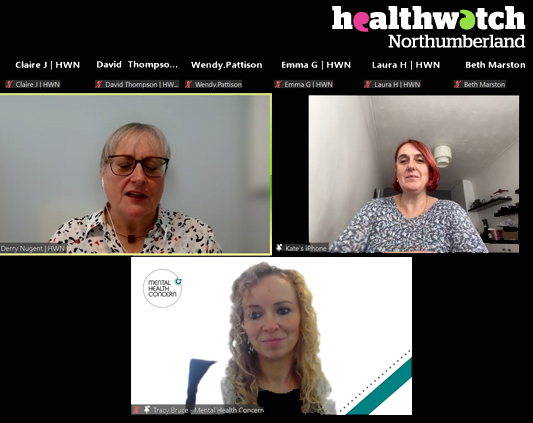
A big thank you to everyone who came along to our AGM and Review of the Year 2021 on 4 November. Special thanks also go to Councillor Wendy Pattison for opening the event, and all at Northumberland Recovery College for their presentation and the taster sessions they provided.

If you missed the event you can view the recording (please note the taster sessions were not recorded).

The draft minutes, plus answers to the questions raised before and during the event can be found below.

Questions for Healthwatch Northumberland

Q: Are people leaving Healthwatch Northumberland for any particular reason?

A: Derry: I’m really happy to say people have left for positive reasons; our young volunteers have gone on to university but with an enhanced CV and other volunteers have gone into work. Our staff member Caroline now works at the Care Quality Commission and Lesley now works at the Clinical Commissioning Group. I feel that Healthwatch Northumberland has enriched those organisations.

Q: People are often concerned about waiting lists for treatment.  What can Healthwatch do around this issue?

Q: Waiting lists are a worry. What is Healthwatch Northumberland going to do?

A: Derry: We will continue to monitor publicly available statistics around waiting times and how Covid-19 recovery addresses those and we will want public feedback about it. It is not something we are seeing coming through at the moment, but we will be monitoring it and once we have got that, we will be having conversations with the NHS.

Q: Regarding your ‘here to hear’ drop-in sessions, why did you choose those five places? Why haven’t you come to Alnwick?

A: Derry: We chose the locations for sessions where we felt we would get a good spread across the county and in places from where we sometimes do not hear enough. However, to make sure we are in the right places so we will give it six months in the current locations and assess if we need to change them.

Q: It would be helpful to have advice and support on how we can develop Patient Participation Groups for a network of practices and Integrated Care System.

Q: My Patient Participation Group stopped meeting due to Covid-19 and has not restarted. Given this is supposed to be a key part of feeding back what can we do about this?

A: Derry:  The first thing we would say to people is to start a conversation within your practice, talk to the practice manager, find out what the plans and ambitions are and how it’s going to work. Now individual practices are part of larger Primary Care Networks, maybe some of that conversation could go on across the network. If you also want at some stage to speak with us we are happy to have that conversation.

The Clinical Commissioning Group would also love to hear from you as we are working together and they are really keen to pull together what is happening across the county. You can contact them through their website or contact Lesley Tweddell who would love to hear from you.

Q: It is difficult for people to actually see a doctor at the moment; particularly older people are struggling as may find the eConsult (online system) difficult to use. Can Healthwatch Northumberland provide support with this?

A: Derry: That is part of the conversation we need to have. If you look at the report we did called Click and Connect, that is part of what we are saying that all these different ways of getting in touch with primary care services are good but we need to make sure people know there is a choice and if people find eConsult difficult, let’s find out why. This is part of the conversation that needs to go on and is going on. We are working the Clinical Commissioning Group around hearing from people about GP access and this is a current piece of work.

Q: You mentioned closely working with other local Healthwatch teams.  Will this mean any of the focus on Northumberland will be lost?

A: Derry: Absolutely not. Our work will always be and can only be Northumberland, but collaboration means you can do greater things and some of the neighbouring Healthwatch share services –  Healthwatch North Tyneside share Northumbria Healthcare NHS Trust and all Tyne and Wear Healthwatch and Northumberland share CNTW NHS Trust (mental health) services so it makes sense that we work together, but our work will always be bringing the voice and experiences of Northumberland into those services.

Q: Last year Healthwatch Northumberland produced an excellent report – Audiology ‘Let’s Talk’, but maybe it and other reports from last year, ‘got lost’ due to Covid-19. Will it be possible to look at the impact of this and the other Healthwatch Northumberland reports?

A: Derry: That is an important issue for us to think about – how do we measure the impact of our work. The Healthwatch Northumberland Board has tasked the staff team to make sure the recommendations we are making in our reports are sensible and achievable, and when they are put to service providers that we get some feedback as to what has happened to them. This year we need to pick up on those recommendations and find out what has happened as a result.

Q: Most of the work you describe seems to be centred around primary care and social care. What work is being carried out with Northumbria Healthcare NHS Trust?

A: Derry: Quite a lot of it – the major piece of work we are working on with them at the moment is End of Life Care. If you look at our quarterly reports you’ll see our routine reporting and feedback and Northumbria Healthcare is figured in there. We have a very open and trusting relationship; we both know we can pick up the phone to each other if there is a problem.

Alan Richardson, Chair Northumbria Healthcare NHS Foundation Trust (in chat): Healthwatch Northumberland is a small but vital partner to Northumbria Healthcare in our service to the people of Northumberland. Their local knowledge is valuable and Derry and her team can carry the messages directly into our Trust through their regular meetings or more quickly if needed. The ICS offers new and interesting opportunities.

Q: My mam had real trouble getting her booster jab sorted through her GP – it took a lot of phone calls.  What can Healthwatch Northumberland do?

A: Derry: Please get in touch with us and tell us more about the circumstances. We would want to share your mam’s experience (anonymously) with both the Clinical Commissioning Group and if necessary the practice. The Clinical Commissioning Group wants to hear about patient experiences of the programme to iron out problems and encourage people to take the vaccine.

Q: Given all the change that will be coming up with the Integrated Care System how will Healthwatch Northumberland maintain stability?

A: Derry: The plan for the Integrated Care System, including the new Care Act, says the new organisation has to work with Healthwatch. As said previously our focus will be Northumberland. Through our engagement and communications we will want to hear what is happening to local services so that we can give this information to the Integrated Care System and quickly spot where things are not going as well as intended or where they are better. The key is to share your experiences with us!

Q: Does Healthwatch England know about Northumberland?  We are a large rural county a long way from London and it is important we are heard. Are we?

A: Derry: Yes. Anonymised information from all enquiries is shared with Healthwatch England where you give us consent.  So they do know what issues you are raising with us and can see how this fits with what is happening in the rest of England. We also share all the reports we produce. This year we are very pleased to be talking at the Healthwatch England Conference about two areas of our work which have been highlighted as good practice.

Questions to Northumberland Recovery College

Q: Wondering about the 2022 Wellbeing Festival. Have you a venue yet?

A: Tracy: We are currently working with partners to look at a variety of locations. We are really spoilt for choice given how beautiful Northumberland is.

Q: Could you provide a little more detail about your co-production process?

A: Tracy: It’s about keeping it fluid. We will go along and speak to groups of residents to find out what they would like to see in their community, find out what’s important, a bit about the area and anything that’s been an issue in terms of wellbeing and look at what activities that group might want to put forward. We also have members of the community on our development group. Throughout we keep checking in to make sure the way we are delivering it is right.

Q: What were your thoughts around the Clinical Commissioning Group bringing together the Northumberland Recovery College?

A: Kate: About 18 months ago the Clinical Commissioning Group along with CNTW, the Mental Health and Disabilities Trust, other partners and Healthwatch Northumberland started to think about what would make the biggest difference in Northumberland – what had people said was missing from our commissioning portfolio. Luckily the Mental Health and Disabilities Trust gave us some money to consider a recovery college, enabling discussions with people with lived experience of mental health difficulties and with people who wanted to support organisations who could come together to form a recovery college. We listened to what people wanted and thought about diversity across large rural areas and urban towns and Mental Health Concern expressed an interest in delivering the recovery college. With Healthwatch Northumberland’s support we shaped up what our expectations would be and what ambition was for people of Northumberland.

Q: How does it differ from what we think of as mental health services, if people are not quite sure, why should we not feel nervous to come to Northumberland Recovery College?

A: Tracy: One of our strengths is that we are approachable, open and friendly and fortunate to have peer supporters – people with lived experience who know how difficult it can be to get through the door. So we can meet people outside, give people sense of what the place is like, who will be there.

Kate: This is not a medical model where people will be assessed and treated or prescribed medication, it’s a service where we build on community and neighbourhood assets to have opportunities to meet people that have similar experiences and try activities for the first time.

Q: How do you communicate with Community Psychiatric Nurses about the Northumberland Recovery College offer?

A: Tracy: We send out regular information to all of our partners but are really keen to come along to any team meeting to give an overview of the work we are doing and how to develop referral processes. Please do get in touch as we are keen to strengthen relationships and keep building as we go along.

Q: How long is this (recovery college) here for?

A: Kate: The service is funded recurrently so we have made commitment as a Clinical Commissioning Group. As we move into the Integrated Care System we are working in close partnership with CNTW –  our Mental Health and Disabilities Trust who will be there throughout the change and are also committed to having a recovery college. The money is there and has been committed for the long-term future.

Q: What is the thing you are most proud of that you have achieved so far?

A: Tracy: The engagement we have done with communities. We have invested in that time and are so proud and humbled that communities are giving us the time to come along and find out what is important to them. And the team – there are so many committed and passionate people and we are privileged to have peer supporters with lived experience working so closely with us.


Healthwatch Northumberland AGM 2021 draft minutes

Feed back on new Elsdon Avenue Surgery

Feed back on new Elsdon Avenue Surgery

Have Your Say on Proposed New Building for Elsdon Avenue Surgery

Elsdon Avenue Surgery is proposing to build a new purpose-built practice half a mile from the current location. This is because the current building needs a lot of maintenance and no longer supports the needs of the service. The layout of the building has no scope to accommodate new services that the practice would like to provide. In addition, parking for patients is limited and there is no provision for those with a disability.

Patients and local residents are being given a chance to ask questions on the proposal for a new surgery. After 12 weeks, all feedback and options for the surgery going forward will be reviewed. The results of all this and what happens next will be shared in early February 2022.

How to leave feedback

  • You can have your say on the proposals for a new surgery building in the following ways.
  • Write to the Practice Manager at The Surgery, Elsdon Avenue, Seaton Delaval, NE25 0BW
  • Contact the Practice Manager by calling 0191 237 2299 or email elsdon.avenuesurgery@nhs.net
  • Ask at reception for a feedback form. This can be filled out anonymously if you wish – you do not need to give personal information if you choose not to.
  • Join us at Healthwatch Northumberland for an online event on Monday 29 November 2021, from 6.00pm to 7.00pm. Please register by emailing: helenb@healthwatchnorthumberland.co.uk. Alternatively you can get in touch with us in a way that suits you, to leave feedback about the proposals.
  • Attend an open afternoon (2pm – 4pm) or evening (5pm – 7pm) on Thursday 2 December 2021 at The Heather Mills Factory, Avenue Road, Seaton Delaval NE25 0QJ.

Elsdon Avenue Surgery proposed new build: FAQs

Why has the decision been taken to build a new surgery in Seaton Delaval?

We wish to remain located in Seaton Delaval.  Our current premises were converted by the former GP himself over 20 years ago and so were never purpose built.  We have no scope for expansion but the number of registered patients is growing quite quickly.  In addition to looking after our patients we also teach medical and nursing students.  We also have other clinical staff helping us – paramedic, pharmacists, the mental health team to name a few – and sometimes we have to turn clinical services at alternative premises because we have no room. Also, the premises are quite dilapidated – for example the windows are rotting; the electrics on the porch doors are unusable; the roof leaks. We also do not have enough car parking for our patients and staff.

When will work begin on the new surgery building? 

We hope it will be within the next 12 months.

Will I continue to go to the current surgery during this work?

Yes, we aim for a seamless handover between one site and the other and notice will be given of when the proposed new surgery is up and running.

Will I be able to consult with my usual doctor or nurse?

Yes, all our staff team will continue to work as normal both during the building works and in the transfer period.

I have a long term health problem – how will this affect my care?

Not at all. Our ongoing care of patients will continue to be our top priority.

 Will there be any change to the service we receive from community services such as district nurses, midwives or health visitors?

No; all these services will continue as before.

Will I be able to access new services at the other surgery?

We hope that the increased space will make it easier to offer additional clinics.  We are looking to increase the amount of psychotherapy time we can offer – as one example.

 Will my medical records be affected?

No; everything will be transferred from one site to the other.

 Will your opening hours change?

The opening hours will only change if central government require a change of all general practice.  Otherwise, we envisage no change.

 What is the likely timescale?

We hope to be ready to open in approximately 18 months.

How can I contact the surgery – will the surgery phone number still be the same?

 You should be able to contact the surgery in the same way that you currently do and the phone number is expected to remain the same.

How can I make appointments?

You will be able to make appointments in the same way at the new site as you choose to use at the old site.  That will not change.

This piece of work has now finished.

NHS waiting lists

NHS waiting lists

NHS waiting lists are inevitable. It’s how we manage them that matters.


A record-breaking 5.7 million people are waiting for hospital care. In response, the Government is spending an extra £5.9 billion to tackle the problem. Healthwatch England‘s latest research looks at how the backlog is impacting the lives of those waiting.
It is well known that COVID-19 has had a significant impact on hospital waiting times.

Early in the pandemic, the NHS postponed lots of non-urgent care, freeing up beds for COVID-19 patients. As things progressed, people put off coming forward with new symptoms because they were simultaneously worried about putting extra pressure on the NHS and the risk of catching COVID-19 themselves.

Most recently, the struggles of seeing a GP may mean there are even more people who need hospital care who simply cannot get referred in the first place.

All this has combined to create a huge backlog of people waiting for a diagnostic test or treatment.

Even with the extra money announced by the Government, long waiting lists are here to stay. The NHS lacks the staff to see people more quickly, and doctors, nurses and other clinicians take a long time to train.

But what does this mean if you or a loved one are currently on a waiting list or think you may need hospital treatment?

Over the last three months Healthwatch England heard from more than 2,500 people about their experiences, helping to dig beneath the headlines and support the NHS to make good policy decisions on how best to manage waiting lists.

Current waiting lists

How long are people actually waiting for care?

Let’s start by looking at how long people are actually waiting for hospital care.

At a glance, media headlines can give the impression that very long waits are the norm and that everyone will be waiting two years to be seen. But in reality, many people will get care much faster than this.

For example, the latest performance figures show that the most typical waiting time is 11 and a half weeks to start treatment.

Of the 2,500 people, nearly one in ten (8%) reported waiting for more than two years to receive care. This is still far too many, given the impact waiting can have on someone’s mental and physical health, but is lower than many may think.

The problem with how waiting lists are talked about is that people may see no point in seeking out a crucial diagnosis or much-needed treatment because they fear they will never be seen anyway or feel guilted into not ‘burdening’ the NHS further. This risks creating even bigger problems for patients and the NHS.

Who is waiting for the longest?

In September, Healthwatch joined forces with the King’s Fund to show that people who live in poorer areas are nearly twice as likely to experience a wait of over a year for hospital care than those in the most affluent areas.

Our further analysis found that people on low incomes are significantly more likely to report living in pain and struggling to manage work and household chores due to their wait.

While the numbers of people from minority ethnic communities who responded to the research was small, there is some indication that people from Black, Asian and ethnic minority backgrounds are experiencing similar issues to those on low incomes. This came through in both our polling and our national survey.

The NHS must look into both of these trends or risk significantly exacerbating existing health inequalities due to how they are managing waiting lists.

Read more

Please tell us your experiences of waiting for NHS treatment